Last updated 2026-08-19
TL;DR
Florida treats paid standing-seam installation as roofing contracting. Get a CILB certified roofing license if you plan to bid work. Statute 489.111 sets a 4-year experience bar for most applicants, plus two exams and insurance. Permits and product approvals stay local, with extra HVHZ rules in Miami-Dade and Broward. Confirm current fees with DBPR. You can work W-2 under someone else's license while you build hours.
How do you start standing-seam roof work in Florida?
Pick a legal lane first. Get hired as a roofing mechanic, or work toward a Florida certified roofing contractor license so you can bid standing-seam jobs yourself. Paid roof work offered to the public is contracting under Chapter 489. I would not hang a truck magnet and hope the county looks the other way.
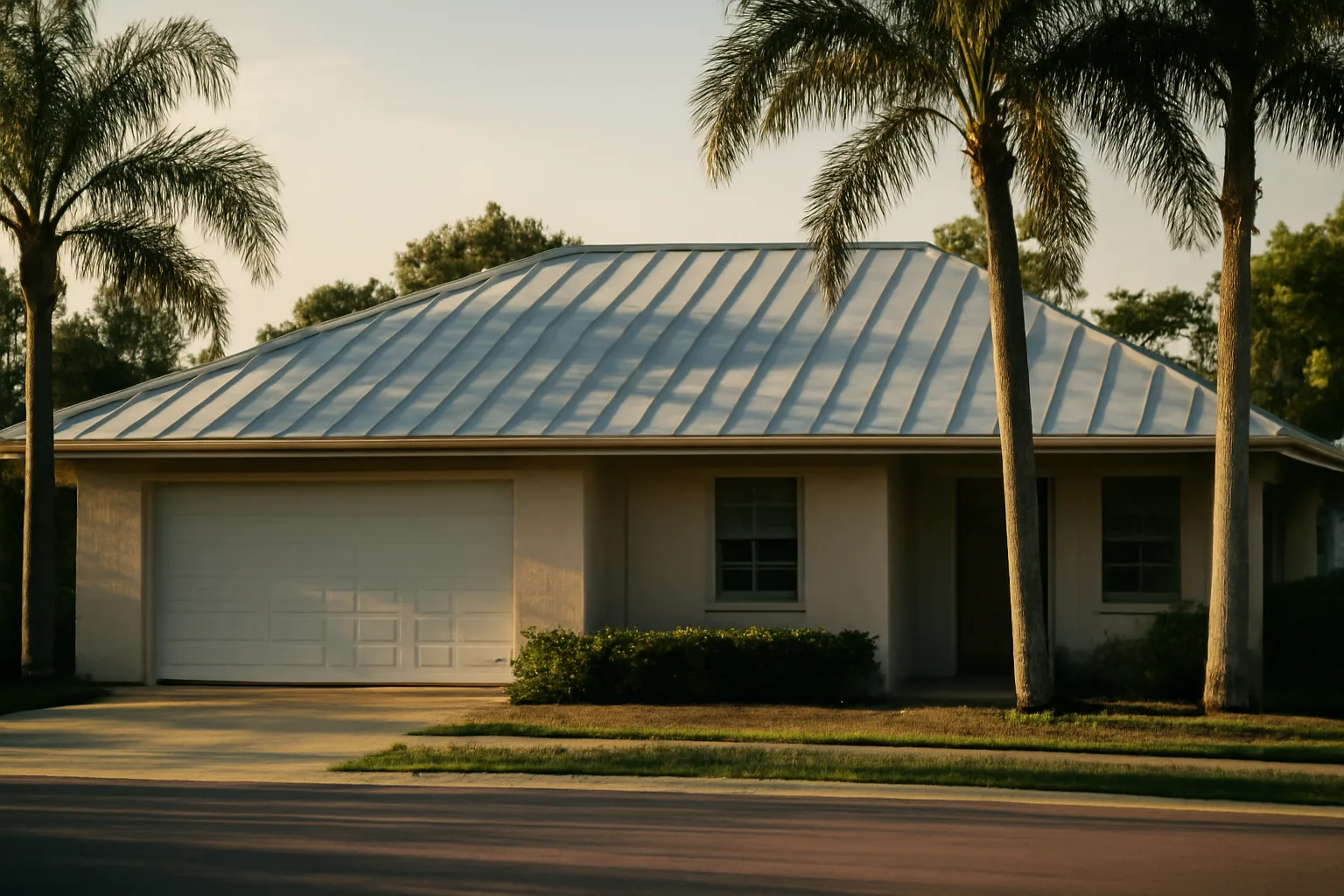
Standing-seam is a metal roof covering with raised, usually mechanically seamed ribs and concealed clips. In Florida it still sits inside the roofing trade. There is no separate standing-seam license. The statutory roofing contractor category covers install, repair, and replacement of roofing systems, including deck attachments and the sheathing work that often shows up on a tear-off. [1]
The sequence I would follow is boring, and it works. Learn the panels on someone else's insurance. Log hours on inland jobs and coastal jobs, because a snap-lock ranch near Gainesville is not the same day as a mechanically seamed system in Broward. Study for the business and finance exam while you still have a paycheck. Form the company on Sunbiz when you are close to applying, not three years early just to look busy.
Tools matter. Paper matters more on day one. You need fall protection that meets OSHA, a way to stage panels without wrecking them, and a seamer that matches the profile you sell. You do not need a portable roll former in month one. Buy panels from a former or distributor until volume is real. StandingSeamPath sells a $149 one-time Seamer + Panel-Math Kit at /start with panel-cut lists and seamer setup notes in one binder. This guide still works if you never buy it.
Roof in another state already? Do not assume the card transfers cleanly. Florida certification is its own exam and its own experience file. The how to start standing-seam roof in Alabama path is a different board, different tests, different local habits.
Do you need a license for standing-seam roof in Florida?
Yes, if you offer standing-seam roof work to the public for pay. Florida does not treat standing-seam as a casual handyman add-on. It is roofing contracting, and Chapter 489 controls who may hold themselves out as a contractor. [1]
You can install as a W-2 employee of a licensed roofing contractor without holding the contractor credential yourself. That is a clean way to start. You cannot advertise, bid, or pull the permit in your own name until you (or your qualifying agent) hold the right CILB license. Unlicensed contracting is a prohibited act under s. 489.127, Florida Statutes. [5]
A lot of new shops try a workaround. They call it "metal trim," "panel supply with install help," or "consulting." Building departments and DBPR investigators have seen all of it. If you are being paid to put a roof on, you are in the roofing trade. Sheet metal contractor scope overlaps some architectural metal, but a standing-seam roof covering is still a roof. I would get the roofing license, not a clever second category, if replacement work is the business.
Homeowners working on their own house sit in a different bucket than a business. Owner-builder rules are local and narrow. They do not let you roof the neighbor's house. If a storm just passed, extra consumer rules kick in and unlicensed door knocking is a fast way to earn a case file.
The license you actually want, if you are new and plan to sell jobs across counties, is a certified roofing contractor through the Construction Industry Licensing Board, administered by DBPR. Registered credentials are local and mostly a legacy lane. Confirm the current application packet on DBPR's construction industry pages before you mail anything. Fees and forms move. [15]
Should you get a certified or registered roofing license?
Get certified if you are starting now and you want to contract. Certified roofing contractors work statewide. You still pull every permit in the city or county that owns the job, and you still follow local product rules. The card itself is not trapped in one town.
Registered roofing contractors are tied to the local jurisdiction that registered them. That lane still exists in statute, but it is a poor plan for a new standing-seam shop that wants to chase work from Jacksonville to Naples. [3]
Here is the comparison I actually use with people entering the trade.
| Path | Where you can contract | Who it fits |
|---|---|---|
| Certified roofing contractor | Statewide (permits stay local) | Anyone new who will sell jobs |
| Registered roofing contractor | Only the registering jurisdiction | Mostly grandfathered shops |
| W-2 mechanic | You do not contract | Hours, skills, year one |
| Unlicensed bidding | Nowhere legal | Nobody you should copy |
I would not spend money on a local registered application if you can sit for certified. The study time is similar. The territory is not.
One split people miss: the qualifier and the company. Florida wants a licensed individual to qualify a business organization. You can be the qualifier on your own LLC. You can also qualify someone else's firm. Do not let a friend "use your license" with a handshake. Put the relationship on the board's forms or do not do it.
How much experience does Florida want before you sit the exam?
Most certified applicants need 4 years of active trade experience. Florida Statute 489.111 is the rule, not a forum rumor. The statute says a person is eligible who "Has a total of at least 4 years of active experience as a worker who has learned the trade by serving an apprenticeship as a skilled worker who is able to command the rate of a mechanic in the particular trade or by having other experience which is approved by the board in the certification category sought." [2]
That experience is roofing experience, not a standing-seam-only log. Shingle years can count toward the roofing category. I still want standing-seam hours on your hands before you sell seamed metal in a wind region. The board is not going to teach you clip spacing.
Education can substitute for part of the time. Degrees and approved programs sometimes swap for years. The mix is in 489.111 and in CILB rule, and it is picky. Do not assume a two-year HVAC diploma knocks out roofing hours. Read the category you are applying for.
Document it like an auditor will read it. W-2s, 1099s if that is really how you were paid, letters from licensed contractors with license numbers, and a job list with addresses beat a vague "I have been in roofs since 2018." Credit for supervising or running jobs is not the same as carrying bundles. Put the role in plain English.
Short on hours? Stay W-2. Paying a coach who promises to invent experience is a waste of money and a good way to earn a denial.
What exams, insurance, and board paper does CILB want?
Plan on two exams: business and finance, plus the roofing trade exam. CILB sets the content in board rule. Pearson VUE or the current vendor runs the seats. I would sit business and finance first while the numbers are fresh, then trade. Confirm dates, retake rules, and scores with DBPR. Nobody honest can promise you a processing calendar. [15]
After the exams, the file is still a pile of paper. Expect fingerprints and a background check, a credit report, financial responsibility showing, and proof of the insurance the board requires as a condition of licensure under s. 489.115. [4] Public liability and workers' compensation (or a valid exemption, which is harder to get in construction than people think) are not optional decorations. Confirm the current dollar limits with the board. I am not going to invent them here because the board and the statute have moved those figures before.
General liability on a metal roof shop should sit above the board minimum if you can buy it. One blown panel through a sliding glass door will explain why. Workers' comp for roofing class codes is expensive in Florida. Budget it as a real line, not a surprise.
Keep the qualifier active. Inactive cards do not let you contract. Renewal, continuing education, and address changes all run through DBPR. Miss those and you get to explain yourself to a building official who already has a line at the counter.
How much does it cost to start a standing-seam roof business in Florida?
The license application fee is real, and it is not the big number. Confirm the current certified contractor fee on DBPR and in Rule 61G4-12.009. Do not trust a blog from 2019. [15]
The costs that actually sting are insurance, a work truck that can carry 20-foot panels without oil-canning them, fall protection, a matching mechanical seamer, hand tools, and the months you are not billing while you wait on a board file. Add a lift or scaffold if you refuse to live on hooks. Add a trailer. Add waste bins.
Florida LLC articles of organization cost $125 on the Division of Corporations fee schedule. [7] An EIN from IRS is free if you apply on the IRS site. [10] Local business tax receipts are extra and they vary by county. I would not open in five counties on day one just to collect receipts.
A portable roll former is the purchase I see new owners romanticize. It is the wrong first buy unless you already have a backlog and a place to run coil. Distributors will sell you panels. Your seamer still has to match that profile. Used seamers that do not match your clip system are scrap with a motor.
Exam prep courses help some people. They are not magic. A used code book, the contractor's manual the board points to, and nights of practice tests have passed a lot of mechanics. If a course promises you will skip the 4-year experience bar, walk away.
Cash buffer matters more than a logo. Roofing in Florida has rain days, insurance inspections, and owners who pay slow after a storm. I would keep enough to cover payroll and materials on one mid-size job without touching the deposit from the next job. That is old advice because it still fails people.
How much does standing-seam roof cost in Florida?
There is no official Florida standing-seam price list. Nobody keeps a clean statewide series for installed standing-seam only. What you can say honestly is that a standing-seam roof florida bid moves with wind rating, panel material, tear-off, story height, and whether the site sits in the High-Velocity Hurricane Zone.
Homeowner price and your job cost are two different questions. Owners pay for design pressure, underlayment, flashings, tear-off, disposal, and the days the crew is on site. You pay for those plus workers' comp, fuel, callbacks, and the seamer that ate a set of rolls. Copy a national "per square foot" screenshot into a Tampa bid and you will lose money or lose the job.
Wind-rated systems, heavier gauges, aluminum or copper, steep or cut-up roofs, and Miami-Dade or Broward NOA assemblies cost more than a simple inland Galvalume snap-lock. Coastal fastening, stainless or heavier clips, and thicker underlayments add up. So does a full dry-in when the afternoon storm cell is already on radar.
Get three written bids if you are the owner. If you are the contractor, bid from a takeoff, not a gut number. Panel count, clip spacing, flashing labor, and seamer time are the guts of standing-seam. Shingle production rates will lie to you.
Insurance discounts can offset some of an owner's cost, but they are not a rebate you control. Florida requires insurers to acknowledge certain hurricane mitigation features, and a uniform inspection form is part of that process. [11] Do not sell a discount you cannot document.
How long does standing-seam roof take in Florida?
A straightforward single-story house, materials on site, seasoned crew, can be a handful of dry days after the old roof is off and the deck is sound. That is a jobsite answer, not a promise. Cut-up roofs, three-story coastal boxes, heavy tear-off, rotten sheathing, and custom flashings stretch into a week or two of calendar time even when the labor hours look smaller on paper.
Permit time is local. Some departments turn a simple reroof in a few days. Others want product approval sheets, engineer letters, and NOA stacks before they stamp anything. Confirm with the building department that owns the parcel. I will not invent a statewide clock.
Weather is the other clock. The Atlantic hurricane season runs June 1 to November 30. [9] You can still roof in July. You also get pop-up storms that shut a dry-in at 2 p.m. Standing-seam hates trapped moisture and rushed flashings. Budget rain days in summer bids or you will work for free.
The license path is measured in years, not afternoons. Four years of experience is the usual bar. [2] Exam seats and board review sit on top of that. If you already have the hours, your delay is study time, fingerprints, and whatever backlog DBPR carries the month you apply. Confirm status in your online account. Do not take a stranger's "six weeks" as a rule.
Material lead time can beat labor time. Special colors, aluminum, and HVHZ assemblies do not always ship this week. Order before you dump the dumpster.
What Florida building code and wind rules apply to standing-seam?
Standing-seam in Florida is a roof assembly under the Florida Building Code, not a product you wing from a national catalog. The 8th Edition (2023) Florida Building Code is the code generation now in force statewide, with an effective date of December 31, 2023. Local amendments still happen. Read the edition the permit is under. [12]
You will hear "design pressure" more than you heard it in a low-wind state. Clip spacing, panel width, gauge, and the underlayment stack have to match an approved assembly for that pressure. A pretty rib profile that is not in the approval is a failed inspection waiting to happen.
High-Velocity Hurricane Zone rules apply in Miami-Dade and Broward. That is a different world of product documents, testing, and inspectors. Inland Florida is still a wind state. Do not treat Leon County like a non-wind job just because it is not HVHZ.
FEMA's wind retrofit guidance for houses treats roof covering and deck attachment as a system. Metal can perform well in high wind when it is the right system, detailed right, and tied to the deck the way the approval says. [14] A floating clip that is missing, or a ridge that is through-fastened like a barn, is how metal roofs get a bad name after a storm.
OSHA is not the building code, but it will still shut your day down. For residential construction, the fall rule is blunt. OSHA says: "Each employee engaged in residential construction activities 6 feet (1.8 m) or more above lower levels shall be protected by guardrail systems, safety net system, or personal fall arrest system unless another provision..." [6] Standing-seam crews love to walk ribs. The standard does not care.
Do you need Florida product approval or a Miami-Dade NOA?
You need an assembly the permit jurisdiction will accept. Statewide, that often means a Florida product approval (the FL number system created in s. 553.842). [8] In Miami-Dade, and in practice across the HVHZ, Miami-Dade product control and Notices of Acceptance sit in the middle of the job. Broward follows HVHZ rules too. [13]
Do not mix a panel from vendor A, clips from vendor B, and a seamer from vendor C unless the approval you stamped on the permit actually allows that mix. Inspectors in coastal Florida will ask. Your distributor should hand you the approval with the takeoff. If they cannot, that is not your panel.
Outside HVHZ, Florida product approval or other accepted documentation still matters. Some jurisdictions are pickier than others. I would rather over-document a reroof in Pinellas than argue on a roof in August.
Owner-supplied leftover panels from a barn job in Georgia are a nightmare. There is no approval trail, no matching clips, and no seamer dies. I would refuse that job. The margin is not worth the failed inspection.
Keep a job folder: approval, NOA if needed, fastening pattern, underlayment spec, and photos of the deck nailing before you cover it. Future you, standing in an insurance dispute, will want those pictures.
How do you set up the company, tax, and workers' comp?
File the entity on Sunbiz before you bid in a company name. Florida LLC articles of organization are $125 on the Division of Corporations fee schedule. [7] Then get a free EIN from IRS if you will hire or open a business bank account. [10] A local business tax receipt comes from the county or city, not from Tallahassee.
Put the license on the business the way CILB wants it, with a qualifier. A random LLC with no qualifier is not a roofing contractor. Bank accounts, contracts, and permit names should match. Building departments notice when the contract says one name and the license says another.
Workers' compensation in construction is not a vibe. Section 440.10 is the core duty to secure compensation. [16] Roofing is high-risk class work. Officer exemptions exist in a narrow form through the Division of Workers' Compensation, and they are easy to get wrong. Confirm your facts on the division's exemption pages before you tell a GC you are "exempt." [16]
Sales tax on materials is a contractor problem, not a mystery. You generally buy materials taxed or accrue tax, depending on the job type. I am not your accountant. Get one who has actually filed for roofers, not a brother-in-law with a spreadsheet.
Written contracts, statutory notices, and Chapter 713 lien paper are part of first-year operations. Handshake roofs after a hurricane are how you work for free. Use a contract that names the assembly, the color, the exclusions, and when draws happen.
What first-year operations are worth it, and what's a waste?
Worth it: a matching seamer, real fall gear, a panel-friendly truck or trailer, a relationship with one good metal supplier, and a habit of photographing decks. Worth it: saying no to a three-story coastal tear-off when your only ladder is a 28-foot extension. Worth it: paying workers' comp on time.
A waste: a wrap on a leased truck before you have a license. A waste: buying coil and a former because a weekend seminar said vertical integration is the future. A waste: bidding HOA clubhouses as job three. A waste: storm chasing with a magnetic sign and no local address.
Hire slow. One mechanic who can flash a chimney on standing-seam is worth more than three helpers who only know shingles. Pay for a day of manufacturer training on the exact panel you sell. That training is cheaper than a ridge that telegraphs waves down the whole slope.
Keep jobs inside your wind comfort zone for a year. An inland 5:12 gable with a simple valley will teach you seaming without a camera crew from the city. Then take the harder coastal work.
Still collecting hours? Stay employed. The W-2 path is slower on Instagram and faster on skill.
How is Florida different from nearby states?
Florida is a board state with a 4-year experience culture, two exams, and wind-driven product rules that Alabama and many inland states do not copy. The standing-seam roof license in Alabama file is not a Florida file with different weather. Read that guide if you might dual-ticket.
Texas metal work is huge, and the paper is still not Florida's paper. Compare Standing-seam roof license in Texas: what you actually need before you assume a Texas card helps at a Miami counter. It will not pull a Broward permit.
Arizona and Arkansas are a reminder that "metal roofing license" is not one national product. See how to start standing-seam roof in Arizona, standing-seam roof license in Arizona, and how to start standing-seam roof in Arkansas if you are moving, not if you are looking for a shortcut around CILB.
What I would do in Florida, stated plainly: work as a mechanic on real metal jobs, log the 4 years (or the portion you still lack), sit the CILB exams, qualify a simple LLC, buy insurance you can actually use, and bid small inland standing-seam until your flashings are boring. Confirm every fee and every form with DBPR and the local building department. StandingSeamPath is an independent publisher, not a law firm and not a service company. No article can stamp your license.
Frequently asked questions
Do you need a license for standing-seam roof in Florida?
Yes if you bid, advertise, or contract the work. Standing-seam sits in the roofing contractor category under Chapter 489. You may work W-2 for a licensed roofing contractor without your own contractor card. Confirm the certified roofing application with DBPR's Construction Industry Licensing Board. Unlicensed contracting is prohibited under s. 489.127.
How much does standing-seam roof cost in Florida?
There is no official statewide price. Bids move with wind rating, HVHZ product rules, material (Galvalume, aluminum, copper), tear-off, and access. National consumer averages do not map cleanly onto Miami-Dade or a simple inland ranch. Owners should collect three written bids on the same assembly. Contractors should take off panels and flashings, not guess from shingle jobs.
How long does standing-seam roof take in Florida?
A simple single-story reroof can be several dry days once materials arrive and the deck is sound. Complex, tall, or coastal jobs run longer. Permits are local and not on a statewide clock. Summer storms and the June 1 to November 30 Atlantic hurricane season add rain days. The contractor license path is usually measured in years of experience plus exams.
Can I install standing-seam on my own house without a contractor license?
Owner-builder rules are local and narrow. They do not let you roof someone else's house, advertise, or sell the job. Even on your own property, permits, product approvals, and inspections still apply. If you are unsure, ask the building department that owns the parcel before you order panels. Hiring an unlicensed crew is still a bad idea.
Is a Florida sheet metal license enough for standing-seam roofs?
I would not rely on sheet metal alone if you sell roof replacements. Standing-seam roof covering is roofing work under s. 489.105. Sheet metal scope overlaps flashings and architectural metal, not a full reroof business. Get the roofing contractor category if that is the work. Holding both is fine. Pretending one is the other is how inspections go badly.
Certified vs registered roofing contractor in Florida: which should I get?
Certified if you are new and want to contract in more than one place. Certified is statewide, with local permits still required. Registered is tied to the local jurisdiction and is a weak plan for a new shop. Confirm which applications DBPR still accepts. I would not chase registered as a shortcut around the certified exams.
Do I need a Miami-Dade NOA if I only work in Orlando or Jacksonville?
Usually no for those cities, but you still need an assembly the local department accepts, often a Florida product approval under s. 553.842. Miami-Dade NOA and HVHZ rules matter in Miami-Dade and Broward. Do not mix random panels and clips. Use the approval that matches what you fasten to the deck.
Can I work under another contractor while I wait on CILB?
Yes. W-2 work under a licensed roofing contractor is the clean way to collect hours and learn seaming without bidding illegally. You cannot advertise as a contractor or pull permits in your name until you qualify. Keep pay stubs and a job list. Those records are what the 4-year experience file is made of.
What insurance do I need to start standing-seam roof work in Florida?
CILB requires proof of the public liability and workers' compensation arrangements in s. 489.115 as a condition of licensure. Confirm current limits with the board. Roofing workers' comp is expensive. I would buy more liability than the minimum if the market will sell it to a new shop. Vehicle coverage is separate and easy to forget.
Are metal roofs required in Florida?
No. The Florida Building Code does not force standing-seam on every house. It does require the covering you pick to meet wind and approval rules for that site. Metal can be a strong choice in wind when the assembly is approved and installed as tested. Shingles remain common. Sell performance, not a fake mandate.
How do wind mitigation discounts work with a new metal roof?
Florida law requires insurers to consider certain hurricane loss mitigation features, and s. 627.711 points owners to a uniform mitigation verification inspection. A metal roof may help a score. It is not an automatic discount you can print on a yard sign. Owners need the current inspection form and their insurer. Do not promise a dollar savings you do not control.
What happens if I contract standing-seam work unlicensed in Florida?
s. 489.127 prohibits holding out and performing contracting without the license. You can face administrative cases, civil penalties, and in some facts criminal charges. Contracts with unlicensed contractors are a mess to enforce. After storms, enforcement gets louder. Work W-2 or get certified. The third option is a case file.
Do I need my own roll former in year one?
Usually no. Buy panels from a former or distributor until you have volume, storage, and a profile you will still sell in two years. Your seamer must match that profile. A used former that runs a dead panel is a large paperweight. I would spend first-year capital on insurance, fall gear, and a seamer, not coil.
Does Florida have a standing-seam-specific contractor license?
No. Standing-seam is a roof covering inside the roofing contractor trade. CILB does not issue a standing-seam card. Your exams, experience, and permits are roofing. Product approvals then control which panel, clip, and fastening pattern you may use on that house. Learn both the license file and the assembly file.
Sources
- Florida Statutes s. 489.105 (contractor definitions, roofing contractor): Florida defines a roofing contractor as unlimited in the roofing trade, covering install, maintenance, repair, and related roofing materials and deck attachments.
- Florida Statutes s. 489.111 (eligibility for certification): Most certified contractor applicants must show at least 4 years of active trade experience approved for the certification category sought.
- Florida Statutes s. 489.113 (qualifications, scope, and use of contractor license): Chapter 489 sets how certified and registered contractors may practice and limits contracting to licensed scope.
- Florida Statutes s. 489.115 (certification, registration, insurance as a condition of licensure): Florida requires certified contractors to meet board licensure conditions, including public liability insurance and related duties set in the statute.
- Florida Statutes s. 489.127 (prohibitions and penalties for unlicensed contracting): Florida prohibits performing acts that constitute contracting without a license and holding out as a licensee.
- OSHA 29 CFR 1926.501 (duty to have fall protection): Residential construction work 6 feet or more above lower levels requires guardrails, a safety net, or personal fall arrest unless another provision in the standard applies.
- Florida Statutes s. 553.842 (product evaluation and approval): Florida maintains a statewide product approval system for building products and systems used under the Florida Building Code.
- NOAA National Hurricane Center, tropical cyclone climatology: The Atlantic hurricane season is June 1 to November 30.
- IRS, Apply for an Employer Identification Number (EIN) online: Businesses can apply for an EIN online through IRS, with no charge for the EIN itself on the IRS application.
- Florida Statutes s. 627.711 (notice of premium discounts for hurricane loss mitigation): Florida requires notice of hurricane mitigation premium discounts and use of a uniform mitigation verification inspection form.
- Florida Building Commission, Florida Building Code information: The 8th Edition (2023) Florida Building Code is the code generation in force statewide, effective December 31, 2023.
- FEMA P-804, Wind Retrofit Guide for Residential Buildings: FEMA's residential wind retrofit guide treats roof covering and deck attachment as part of a high-wind roof system.
- Florida DBPR, Construction Industry licensing program: DBPR's Construction Industry unit administers CILB contractor applications, exams, and license records.
- Florida Statutes s. 440.10 (workers' compensation liability for compensation): Florida construction employers must secure workers' compensation coverage as provided in Chapter 440.