Last updated 2026-08-21
TL;DR
In Florida, standing-seam installation is roofing contracting. You need a certified or registered CILB roofing license unless you work under one. Applicants generally need 4 years of experience, plus exam, insurance, and financial paperwork. The state does not set a standing-seam price. A house job often runs days to a couple of weeks after the permit. Confirm fees with DBPR.
What does standing-seam roof renewal mean in Florida?
Standing-seam roof renewal in Florida is two jobs that share one search box. One is the physical reroof, meaning panels, clips, underlayment, and a local permit. The other is keeping a Florida roofing contractor license current. If you are entering the trade, the license is the gate. If you already hold the license, renewal is continuing education plus whatever the Department of Business and Professional Regulation has on your cycle.
People mash those two piles together because both involve paper, money, and metal. I keep them labeled.
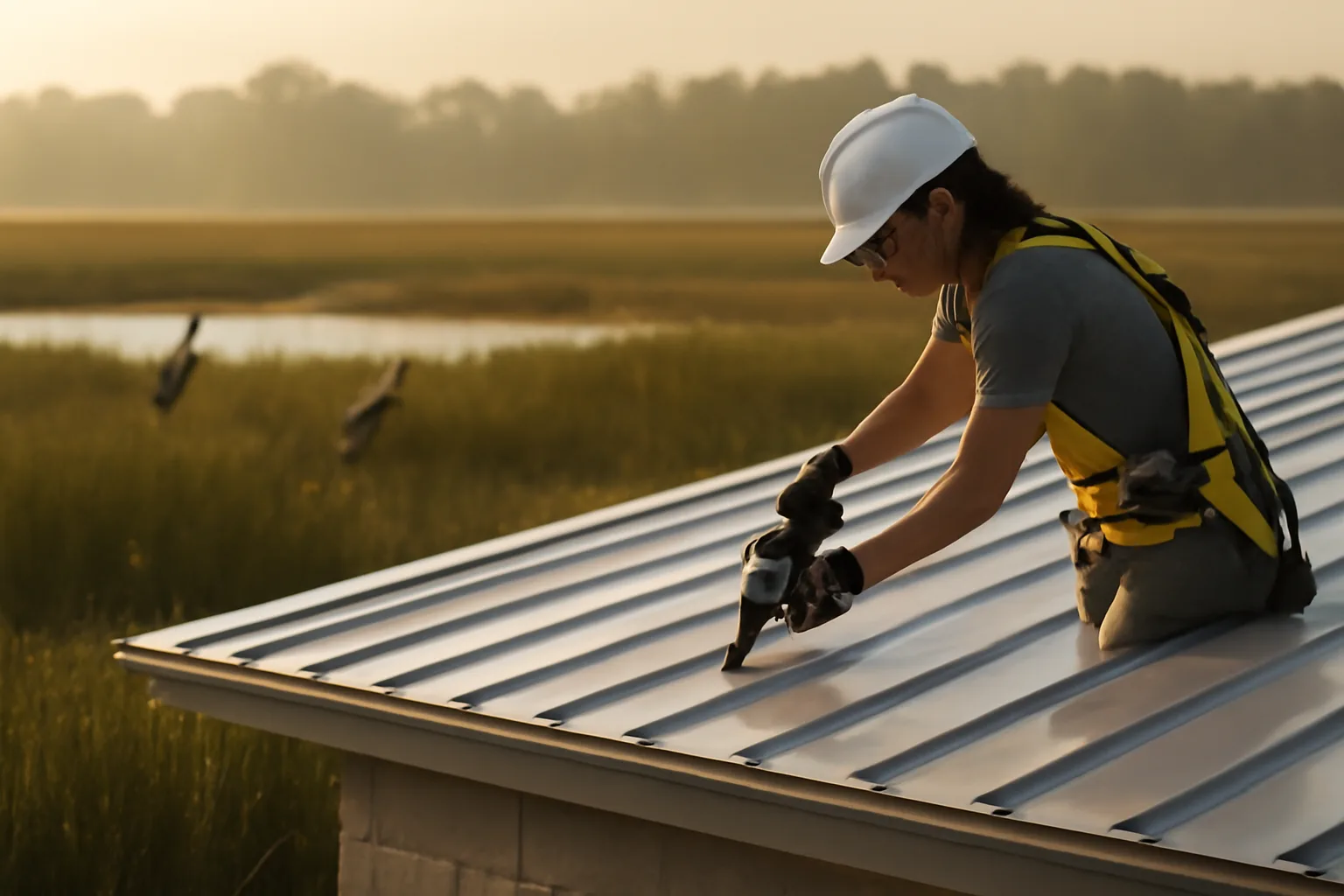
A standing-seam roof uses long metal panels with raised legs that get locked so fasteners sit concealed. In Florida that roof still needs a legal contractor when you sell the work, a building permit, and a product-approved assembly. Inspectors walk it with the same attitude they bring to tile. No special halo.
If a national video told you metal is maintenance free and unlicensed, close it. Coastal wind and Chapter 489 do not care about the video.
This guide is for people who want the real paper path into standing-seam work, not a franchise story. It is also for licensees who have not looked at renewal rules since the last named storm. One guide does not replace the statute book or your building official. Start with who may contract. Then price and schedule. Then the High-Velocity Hurricane Zone stack. That order keeps you from buying a seamer for work you cannot legally sell.
Do you need a license for standing-seam roof in Florida?
Yes. If you contract standing-seam work for other people, Florida treats it as roofing contracting. You need to be a certified or registered roofing contractor, or an employee of one. The statute is blunt. "No person who is not certified or registered shall engage in the business of contracting in this state." [2]
Homeowners working on their own homestead get a narrower owner-builder lane. That lane is not a free pass to flip roofs for neighbors. It is a bad way to start a shop.
Certified roofing (the CCC number people chase) is the statewide contractor license. Registered roofing ties you to a local competency finding and a tighter territory. Most crews that want standing-seam work across county lines want the certified path. [4]
Unlicensed contracting is not a cute paperwork miss. Chapter 489 sets criminal and civil penalties, and the building department can stop the job. [5] I would not take deposits and "sort the license later." That is how people lose the truck.
Employees of a licensed contractor do not each need a contractor license to run a seamer. The qualifier still owns the work. If you sign the contract, you need the license or you need to sit under someone who has it.
A mill certificate is not a license. A city business tax receipt is not a license. Look the number up on DBPR before you believe a truck door.
What Florida license actually covers standing-seam work?
A Florida roofing contractor license covers standing-seam. Florida Statute 489.105 defines a roofing contractor as "a contractor whose services are unlimited in the roofing trade" and includes install, maintain, repair, alter, and extend work on roofing and waterproofing. [1]
You do not get a separate standing-seam-only state license. Some counties still run local competency cards. Those cards do not replace the state roofing license when the job is contracting.
People mix sheet metal contractor and roofing contractor. Architectural sheet metal and mechanical specialty licenses are different scopes. Standing-seam roof systems on buildings sit in the roofing box. If a job mixes gutters, copper valleys, and a full panel replacement, stay inside the scope printed on your license. When a scope question is close, ask the board in writing. Guessing is how you eat a citation.
I would not buy a metal-roof class from a panel mill and call it a license. Mill training is useful for clip schedules and warranties. It is not Chapter 489.
| Item | Certified roofing | Registered roofing |
|---|---|---|
| Statewide contracting | Yes, subject to local business tax or registration some cities still want | No, limited to the jurisdiction that found you competent |
| Who issues it | CILB through DBPR | Local competency board plus state registration |
| Typical standing-seam use | Multi-county crews | One-county shops |
Confirm which ticket you actually hold before you bid the next county over. The card text wins, not the decal on the trailer.
How do you get a Florida roofing contractor license?
You apply through DBPR to the Construction Industry Licensing Board. The exam path generally needs at least 4 years of active experience in the trade. Approved school and apprenticeship can count toward that pile, but the board reads the dates. [3] You also sit for the exam, pass a background check, and show financial responsibility and insurance. [4] [7]
I will not quote a current application fee or a processing clock. Those numbers move. Confirm them on the live DBPR checklist for Certified Roofing Contractor. Anyone selling a fixed approval date is lying.
The experience letters are where files stall. Get dated, specific letters from licensed contractors who can swear to the work you did. "Helped on roofs" is junk. Panel runs, flashings, tear-offs, and who supervised you are what a reviewer can use.
If your hours are mostly standing-seam, say so. The license is still a general roofing license. You get tested on built-up, shingles, tile, and waterproofing. Study the whole trade. Metal-only mechanics fail the business exam when they treat it like a seamer quiz.
Once you pass, you still need the insurance certificates and the financials before the card is useful. Do not bid while the file is pending. Pending is not licensed.
Florida Statute 489.111 is the statute to read first on the exam path. Pair it with Rule 61G4-15.001 on qualification. Then use the board's current forms, not a blog checklist from 2019.
How does Florida roofing license renewal work?
Florida contractor licenses run on a biennial cycle with continuing education. Board rule requires 14 hours of continuing education each biennium for registered and certified contractors. [6] Confirm the current subject split (laws and rules, safety, workers' compensation, wind mitigation, and the rest) on Rule 61G4-18.001 before you buy a cheap 14-hour bundle.
Miss the window and you are in delinquency and reactivation rules under Chapter 455, not a friendly reminder email. [15] Confirm status in your DBPR account. Do not take a deposit on an expired number.
I track CE in a folder with certificates, not in a text thread with a provider. When a complaint hits, you will want paper.
Renewal is not a new exam if you stay current. That is the whole point of staying current.
If you change your qualifier, address, or insurance, those are separate board notices. A standing-seam crew that keeps working after the qualifier leaves is a classic complaint file.
I will not invent your expiration date. Odd and even license cycles and any late fees belong on the board's invoice, not in this guide. Log in and read the account. If a CE vendor swears your course "always posts overnight," still verify it posted.
How much does standing-seam roof cost in Florida?
There is no official Florida standing-seam unit price. DBPR does not publish one. The Florida Building Commission does not publish one. Anyone giving you a single statewide average per square as if it were a statute is selling something.
What actually moves the number: HVHZ versus inland wind, 24 versus 26 gauge, mechanically seamed versus snap-lock, tear-off layers, deck rot, approved underlayment, edge-metal testing, coastal access, and whether the product has a current Florida product approval or a Miami-Dade Notice of Acceptance. [13] [14]
Get three written bids on the same scope. Make each bid name the panel profile, gauge, coating, clip or seam type, underlayment, and the FL approval number or NOA. If a bid just says metal roof, throw it out.
For a homeowner, standing-seam costs more up front than asphalt. The U.S. Department of Energy treats metal roofing as a durable choice that can use reflective coatings, which is one reason people swallow the bid. [11] I still would not finance a standing-seam roof with a door-knocker who wants a same-day cash deposit.
For a new shop, your first-year money pit is not the seamer. It is insurance, workers' compensation, a yard, a way to move long panels, and the weeks you sit unproductive while the license file crawls. Price jobs with burdened labor, not hope.
Waste of money: custom color-match on a starter spec house, buying every panel profile "to be ready," and national franchise fees that do not put a qualifier on your wall.
If you are still learning takeoffs, a simple panel-math worksheet beats a pretty app you will not open on the roof. StandingSeamPath publishes a $149 one-time Seamer + Panel-Math Kit at /start. This guide stands alone without it.
How long does standing-seam roof take in Florida?
For a typical single-family reroof, field time is often a few days to about two weeks once materials and the permit are in hand. Big or steep roofs, tile tear-offs, deck replacement, and coastal edge details run longer. Nobody has a clean statewide time study I trust. Weather and inspection cycles dominate.
The paper takes longer than the seamer. Product approval checks, HOA packets in some neighborhoods, and permit review in Miami-Dade or Broward can sit for a stretch you cannot honestly promise. I will not give you a permits-in-X-days number. Confirm with the building department that will stamp the job.
License time is a different clock. Exam prep, experience letters, and board review are measured in months for a lot of people. Confirm current processing language with DBPR. No approval promise.
If a salesperson says they will do the whole house Saturday, they are either overlaying something you should not overlay or skipping inspections. Walk away.
Crew size matters. A two-person standing-seam crew on a simple gable is a different week than a cut-up coastal roof with chimneys and a pool cage. Bid time from a sketch and a site visit, not from a Facebook ad.
Hold weather days in the contract. Summer storm cells shut a metal roof down whether your customer likes it or not. Promise a start window, not a miracle finish date.
What building-code and HVHZ rules change a Florida standing-seam job?
Miami-Dade and Broward are the High-Velocity Hurricane Zone. The 2023 Florida Building Code says that zone consists of those two counties. [9] Inside HVHZ, roof products and edge systems run through a tougher approval path, often a Miami-Dade Notice of Acceptance. [14] Everywhere else in Florida you still need Florida product approval for the system you put on the building. [13]
The Florida Building Code is the statewide minimum code. Local amendments still happen, so read the county packet. [12]
Windborne debris, roof-to-wall hardware, and opening protection sit in the wind-mitigation statute the commission writes into the code. [8] I would not import a Midwest snap-lock spec and hope. Clip spacing, oil-canning, and coastal fasteners are Florida problems. Use the evaluated assembly.
Underlayment is not a place to save forty dollars a square. In a reroof, the underlayment and the deck condition decide whether the metal even matters.
| Topic | HVHZ (Miami-Dade, Broward) | Rest of Florida |
|---|---|---|
| Product path | Miami-Dade NOA or other HVHZ-accepted assembly | Florida product approval (FL number) |
| Who to call first | County product control plus the building department | Local building department plus the product-approval search |
| Common failure | Using an inland snap-lock system that was never tested for that zone | Bidding a brochure system with no FL number |
Compare notes with how other states handle the same panels. Georgia's paper path is a different board. standing-seam roof renewal in georgia Alabama is another. standing-seam roof renewal in alabama
What paper do you need before you start a Florida standing-seam job?
You need a license in good standing, any local contractor registration the city still wants, a permit, and product approval or an NOA for the exact panel, clip, and fastener schedule. You also need workers' compensation or a legal exemption, a general liability certificate, and a written contract that matches Florida contracting rules. HOA approval if the deed says so.
Site-specific paper includes existing roof layers, an asbestos test on old built-up if that is what you are tearing off, a fall protection plan, and dump tickets.
OSHA still wants fall protection on residential construction at 6 feet. [10] A harness that lives under the seat does not count.
I keep a simple permit folder: contract, product pages, FL number or NOA, layout, and insurance. Inspectors are human. Hand them a stack that makes the assembly obvious.
Do not start tear-off before the permit is issued unless the building official said you can in writing. The lady on the phone said it was fine is not a defense.
If the house sits in a flood zone or on the open coast, ask the building department about elevation certificates and whether roof work trips other upgrades. Do not assume a metal reroof is "just a reroof" on a 1970s waterfront box.
What insurance and money rules trip new Florida roofing shops?
Chapter 489 and the board rules make you show public liability insurance and workers' compensation arrangements as part of licensure. [4] The dollar limits on the certificates change. Confirm current limits with CILB. I will not invent them.
Workers' compensation exemptions are narrower than Facebook thinks. If you have employees, budget the real policy.
Financial responsibility is a board review, not your cousin saying you are good for it. [7] Keep business and personal money apart from day one.
I think paying a consultant to package a thin experience file is often a waste. Paying a CPA to set up the books and a competent insurance broker is not.
Deposits and contract clauses are regulated. Read the contracting pieces in Chapter 489 before you copy a Texas template. Confirm current required contract language with the board or a Florida construction lawyer. StandingSeamPath is not a law firm and not a service company.
Cash-only standing-seam ads are a red flag for homeowners and a trap for new shops. You will need a paper trail when a seam weeps after the first summer storm.
What should you confirm with the board before you spend money?
Confirm the current application fee, fingerprint vendor, exam vendor, experience form, financial statement form, insurance limits, CE course list, renewal deadline for your license number, and whether your local government still requires a separate registration. Confirm those on DBPR and CILB documents, not on a forum post.
Confirm product approvals on the Florida Building Code product-approval search, not on a sales flyer. [13] In Miami-Dade, confirm the NOA is active. [14]
Confirm wind speed and exposure with the project engineer or the local building department. Do not pull a number off a national map app and cut clips to it.
If you plan to work other states later, their boards do not care about your Florida mill cert. Look at standing-seam roof renewal in california and standing-seam roof renewal in arizona before you assume reciprocity. Reciprocity is a board decision, not a vibe.
I would print the statute and the rule, highlight the experience and CE lines, and walk into the exam prep with those pages. Secondary blogs go stale. The numbered statute stays put until the legislature moves it.
What is a waste of money in year one, and what is not?
Waste: a second portable seamer before you have work, vinyl wrap on the truck, a franchise that does not include a qualifier, buying 26-gauge residential snap-lock for HVHZ jobs that will not pass, and paying for expedited license outfits that cannot actually move DBPR.
Not waste: a reliable mechanical seamer if you sell true double-lock standing seam, fall gear people will wear, a brake you know how to use, and CE courses you stay awake in.
Illinois and Colorado shops run different snow and hail problems than you will. Still useful to see how their paper reads. standing-seam roof renewal in illinois standing-seam roof renewal in colorado
Buy tools after you have a license path and a panel source, not the other way around. A seamer in the garage does not pull a permit.
StandingSeamPath is an independent publisher, not a law firm and not a contractor. For a panel takeoff kit see /start. Confirm every fee and date with DBPR and the local building department. No approval or timing promise here is worth anything next to the board's own page.
How should a homeowner vet a standing-seam contractor in Florida?
Look the license up on DBPR, match the business name to the contract, ask for the FL product-approval number or Miami-Dade NOA, and get a written scope. Skip anyone who wants a huge cash deposit today or who will not name the panel.
Ask who the qualifier is. If the charming salesperson is not on the license and cannot name the qualifier, slow down. Ask how they handle rain during a tear-off. Ask who pulls the permit.
Three bids. Same scope. Same gauge. Same underlayment. If one number is half the others, they left something out or they are not licensed for the work.
You can install standing-seam on your own homestead in some owner-builder situations, but you still need a permit and a legal assembly. Most homeowners should not learn a mechanical seamer on a coastal house. Hire the ticket.
After the job, keep the product pages and the permit card with the closing file. Insurers and the next buyer will ask. A standing-seam roof Florida homeowners brag about is only as good as the approval number under it.
Frequently asked questions
Do you need a license for standing-seam roof in Florida?
Yes if you contract the work. Florida treats standing-seam installation as roofing contracting. You need a certified or registered CILB roofing license, or you work as an employee of a licensee. Owner-builder work on your own homestead is a narrower exception. Confirm your facts with DBPR before you collect a deposit. Unlicensed contracting carries penalties under Chapter 489.
How much does standing-seam roof cost in Florida?
The state does not publish a standing-seam unit price. Installed cost is a local bid driven by wind zone, gauge, seam type, tear-off, deck repair, and whether the system has a current FL product approval or Miami-Dade NOA. Ask three contractors for the same written scope. Treat any single Florida average you see in an ad as marketing, not a board figure.
How long does standing-seam roof take in Florida?
Field work on a straightforward house is often a few days to about two weeks after materials and the permit are ready. Cut-up roofs, tile tear-offs, deck rot, and HVHZ inspections take longer. Nobody has a solid statewide time study. Permit review time is set by the local building department. Confirm that clock locally. Do not promise a Saturday finish to win a bid.
How many years of experience do you need for a Florida roofing license?
Florida Statute 489.111 generally requires at least 4 years of active experience for the examination path, with limited credit for approved school or apprenticeship. The board reviews letters and dates. Confirm how your hours count on the current DBPR checklist. Do not assume unsupervised side jobs will count.
How many CE hours does Florida roofing license renewal take?
Rule 61G4-18.001 requires 14 hours of continuing education each biennium for certified and registered contractors. Confirm the required subjects on the current rule text before you buy a course pack. Keep the certificates. An expired license is not cured by a good seamer. Confirm your actual deadline in your DBPR account.
Is Miami-Dade different for standing-seam metal roofs?
Yes. Miami-Dade and Broward are the High-Velocity Hurricane Zone in the 2023 Florida Building Code. Roof assemblies usually need a Miami-Dade NOA or another HVHZ-accepted path. Inland Florida still needs Florida product approval. Confirm the active approval number before you order panels. Do not reuse an inland snap-lock spec on a barrier-island house.
Can I use a registered roofing license statewide in Florida?
No. A registered roofing license is tied to the local jurisdiction that found you competent. Certified roofing is the statewide contractor ticket. Some cities still want a local business tax or registration even if you are certified. Ask that city before you bid. Working outside your registered territory is how complaints start.
Does a metal manufacturer certification replace a CILB license?
No. A manufacturer standing-seam certificate helps with warranty and install details. It does not authorize contracting in Florida. Chapter 489 still applies. You can hold both. You cannot substitute the mill card for the state license when you sign a contract or pull a permit.
Do standing-seam roofs need Florida product approval?
Yes. Use a system with a current Florida product approval number, or a Miami-Dade NOA in the HVHZ. Match clip spacing and fasteners to the evaluated assembly. A pretty brochure is not an approval. Search the live Florida product-approval database and print the page for the permit folder.
Can I work as a standing-seam helper without a contractor license?
Yes, as an employee of a licensed roofing contractor. You cannot advertise, contract, or pull permits as the contractor. The qualifier is responsible. If you start collecting job money in your own name, you have crossed into contracting. Get on payroll or get licensed. Handshake cash jobs are how both of you get burned.
What happens if I contract roofing without a Florida license?
Chapter 489.127 sets criminal and civil penalties for unlicensed contracting. Building departments can issue stop-work orders. Customers can walk away and report you. I would not test this to "get cash flow going." Get licensed or work under a licensee. Confirm current penalty language in the statute, not in a group chat.
When should I talk to the local building department?
Before you bid a firm number, and again before tear-off. Ask about permit submittals, HVHZ or product-approval requirements, inspection holds, and any local reroof rules. The AHJ, not a supplier, decides what they will inspect. Bring the product pages. A five-minute counter visit beats a failed inspection with the old roof in a dumpster.
Are standing-seam roofs better in hurricanes than shingles?
A tested, well-attached standing-seam assembly with proper edge metal and deck attachment can perform well in high wind. A cheap snap-lock with wrong clips will not. Performance follows the approved assembly and the fastening, not the word metal. Use FBC product approval or a Miami-Dade NOA, and install what that document actually evaluated.
Where do I confirm current Florida roofing license fees?
Use your DBPR account and the Construction Industry Licensing Board application checklist for Certified or Registered Roofing Contractor. Fee tables change. I will not invent a current fee here. If a third party quotes a fee, verify it on the board document before you pay anyone.
Sources
- Florida Senate, Statute 489.105 Definitions: A roofing contractor is defined as unlimited in the roofing trade, including install, maintain, repair, alter, and extend roofing and waterproofing.
- Florida Senate, Statute 489.113 Qualifications for practice; restrictions: No person who is not certified or registered shall engage in the business of contracting in Florida.
- Florida Senate, Statute 489.111 Licensure by examination: The typical examination path requires at least 4 years of active experience in the trade.
- Florida Senate, Statute 489.115 Certification and registration; insurance: Certified and registered contractors must meet board certification or registration rules, including required insurance showings.
- Florida Senate, Statute 489.127 Prohibitions and penalties: Unlicensed contracting is subject to criminal and civil penalties under Chapter 489.
- Florida Administrative Code Rule 61G4-18.001 Continuing Education Requirements: Certified and registered contractors must complete 14 hours of continuing education each biennium.
- Florida Administrative Code Rule 61G4-15.001 Qualification for Certification: CILB sets qualification, experience documentation, and related certification standards for contractor applicants.
- Florida Senate, Statute 553.844 Windstorm loss mitigation: The Florida Building Commission must adopt Florida Building Code requirements for windstorm loss mitigation, including roof-related protections.
- ICC Digital Codes, 2023 Florida Building Code Chapter 2 Definitions: The High-Velocity Hurricane Zone consists of Broward and Miami-Dade Counties.
- OSHA, 29 CFR 1926.501 Duty to have fall protection: Residential construction generally requires fall protection at 6 feet or more above a lower level.
- Florida Senate, Statute 553.73 Florida Building Code: The Florida Building Code is adopted as the statewide minimum building code.
- Florida Building Commission, Product Approval Search: Roof systems used in Florida are looked up and documented through the state's product-approval program.
- Miami-Dade County, Product Control Notice of Acceptance (NOA) Search: HVHZ roof assemblies are documented through Miami-Dade Notice of Acceptance approvals.
- Florida Senate, Statute 455.271 Inactive and delinquent status: Professional licenses that are not renewed fall under inactive and delinquent-status rules in Chapter 455.